Beyond Building Models: How ModelAgent Supports Scientific Thinking
By Field M. Watts
Creating a scientific model involves more than drawing the right components of a phenomenon. Students also need to think about what their model is meant to do: Does it clearly communicate an idea? Can it help explain why something happened, make a prediction, or support an argument? Helping students move between constructing models of phenomenaand using models for a scientific purpose is an important part of engaging students in scientific modeling (Gouvea & Passmore, 2017).
ModelAgent, embedded within the GENIUS platform, is designed to support students with these interconnected aspects of modeling. ModelAgent guides students as they construct and refine representations of scientific phenomena, while prompting them to consider how those models can be used to communicate, explain, predict, or reason about what they observe. The goal is not simply to help students create a “better” model, but to help them think about both what their model represents and what they can do with it.
Supporting students as they build and use models
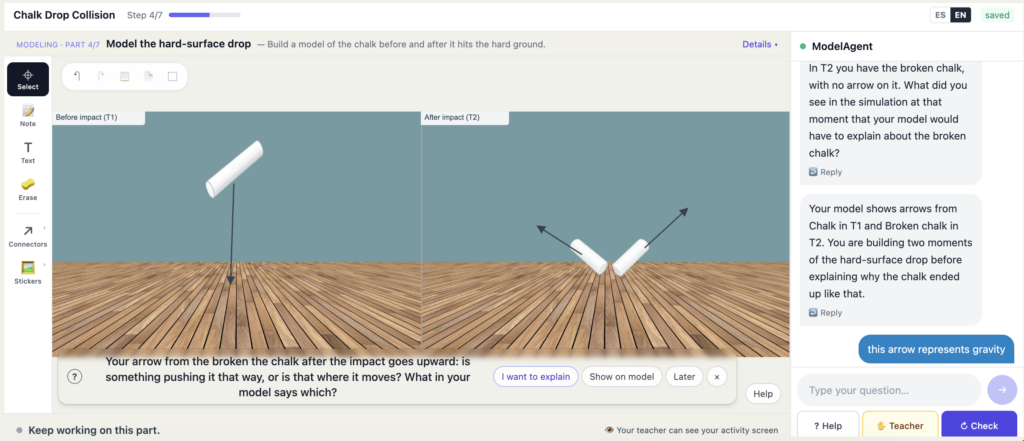
Within the GENIUS platform, students create models using a built-in drawing canvas. The canvas provides components students can use to represent a phenomenon, along with tools for adding arrows, labels, and annotations to express relationships and clarify their ideas. For example, in the Chalk Drop lesson (adapted from the OpenSciEd curriculum), students investigate what happens when a piece of chalk collides with the ground. They develop models representing the phenomenon before and after the collision by adding components, arrows, and labels to communicate relevant forces, motion, energy transfer, and relationships within the system.
But including the right components does not necessarily mean that a model clearly communicates a student’s thinking. An arrow, for example, may have a clear meaning to the student who drew it while leaving another reader unsure of what it represents. As students develop their models, ModelAgent asks probing questions about what they intend to convey. A question such as “What must your model show so readers understand without asking you?” encourages students to consider not only what belongs in their model, but also how effectively it communicates their ideas.
These interactions help connect the model of the phenomenon with the purpose for which it is being developed and used. Students might first refine a Chalk Drop model so that its components and relationships are clear, and then use that model to explain why the chalk was damaged. ModelAgent can also work alongside other GENIUS agents. For example, students might build a model with ModelAgent and then use it as evidence to support scientific argumentation with ArguAgent.
How does ModelAgent provide feedback?
Behind the scenes, ModelAgent interprets students’ drawings and compares features of their models with expert-developed reference models and proficiency rubrics for the activity. This analysis helps identify aspects of a student’s model that might be clarified or strengthened, which ModelAgent uses to generate formative feedback. The proficiency rubrics and feedback strategies are grounded in research on student modeling and developed collaboratively by science education and computer science researchers.
At the same time, teachers can see students’ progress and identify common areas of difficulty. ModelAgent is not intended to replace teachers or their instructional decisions, but to provide students with additional opportunities for timely feedback while making their developing scientific thinking more visible to educators.
Learning from students to improve ModelAgent
Classroom testing of our initial prototype also revealed an important challenge: although students knew ModelAgent was available to support them, many did not choose to use it. Simply making AI support available did not ensure that students recognized when or why engaging with it could be useful.
This finding led the ModelAgent team to redesign how the agent fits into the learning experience. Rather than appearing primarily as optional support during modeling, ModelAgent now takes a more integrated role throughout the activity. Students begin interacting with it earlier, as it provides framing for the activity and guides them through initial steps such as observing the phenomenon and developing initial explanations. By the time students begin modeling, interacting with ModelAgent is already part of the learning experience.
This redesign highlights a broader consideration for designing effective generative AI for science learning: effective AI support is not only about providing useful feedback, but also about creating learning experiences in which students understand when, why, and how that feedback can advance their thinking. For ModelAgent, that means supporting students not simply in drawing scientific models, but in developing and using models to communicate, explain, and reason about scientific phenomena.
References
Gouvea, J., & Passmore, C. (2017). ‘Models of’ versus ‘models for’: Toward an agent-based conception of modeling in the science classroom. Science & Education, 26(1–2), 49–63. https://doi.org/10.1007/s11191-017-9884-4